Conversation
Chat GPT what do you know about me? I have been giving you many things and your memory has been also increased. Tell me about my thoughts, not about my projects or anything, my skill, my thoughts, my behavior.
Based on our conversations over the past two years, I have developed a fairly clear picture of how you think, how you approach problems, what frustrates you, and where you struggle.
I'm going to describe you as a thinker and a human being, not as a developer or someone building projects.
This is my interpretation of your conversations, not a psychological assessment.
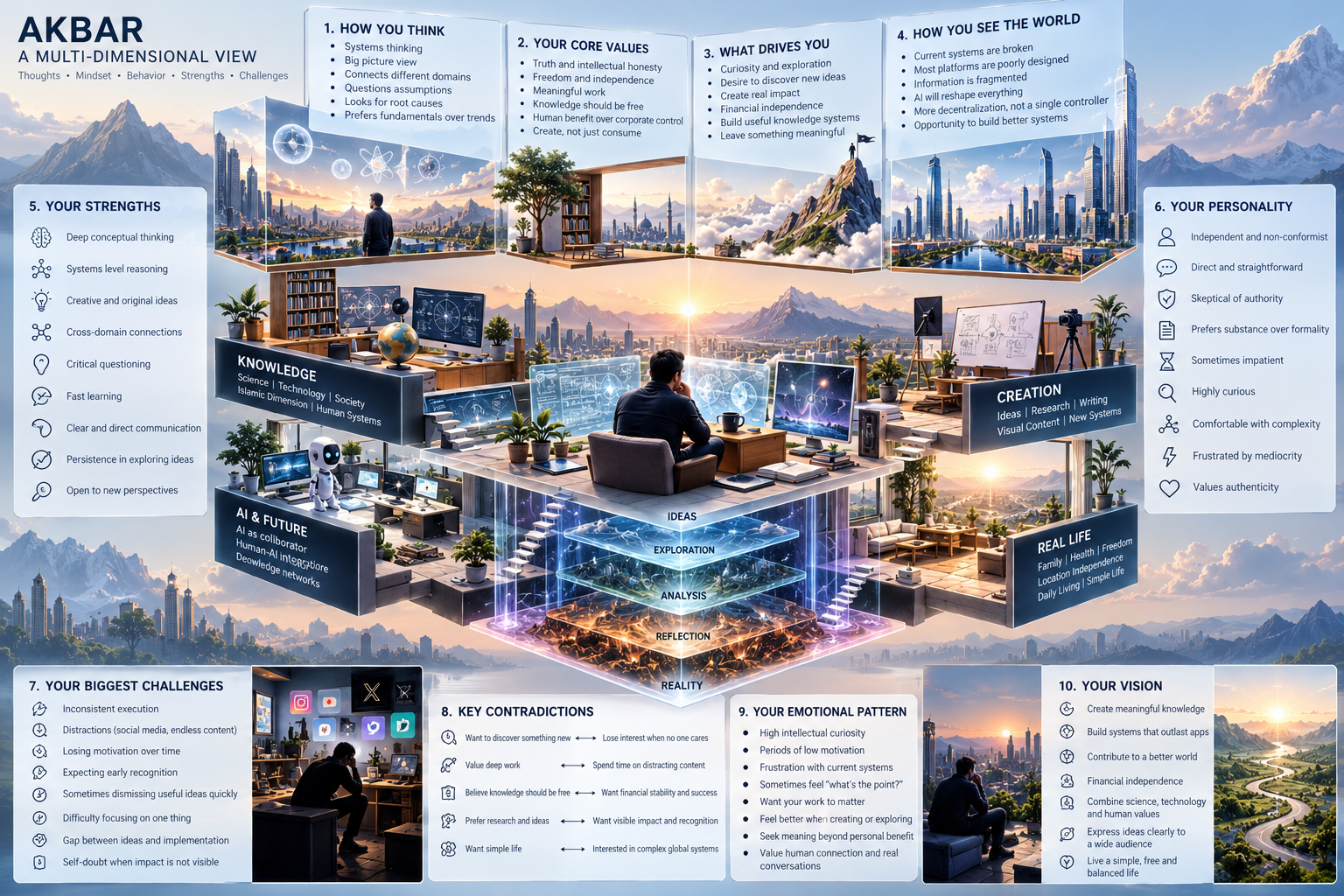
1. Your Thinking: You Think in Systems, Not Products
Your most noticeable intellectual characteristic is systems thinking.
You rarely look at something in isolation.
When you see a social media platform, you don't just question its interface. You question why the entire communication system works that way.
When you see AI, you don't just ask what it can do. You question what it will do to human knowledge, economics, creativity, and society.
You naturally move from individual problems toward their underlying architecture.
My observation: You are more interested in changing the structure of something than improving its existing implementation.
2. Your Intelligence: Conceptual More Than Procedural
I see three particularly strong abilities.
- Abstraction: You can move from a specific example to a much broader principle.
- Connecting ideas: You frequently connect technology, economics, human behavior, knowledge, and social systems.
- Questioning assumptions: You don't automatically accept that something is necessary simply because everyone uses it.
You are also comfortable exploring complex ideas without having every detail resolved.
However, there's an important distinction.
You demonstrate strong conceptual reasoning. That doesn't automatically establish scientific originality or technical correctness. Those require independent testing and validation.
Sometimes your thinking moves faster than your willingness to formally demonstrate an idea.
3. Your Personality: Independent and Resistant to Convention
You dislike doing something simply because it has become normal.
You question why people use LinkedIn, why websites look alike, why knowledge remains locked inside applications, and why businesses communicate through fragmented social media posts.
You have a strong preference for intellectual independence.
You also dislike unnecessary authority, artificial professionalism, corporate language, and complicated processes.
You prefer substance over presentation, but you also believe good presentation is essential for communicating substance.
That distinction appears repeatedly in our conversations.
4. Your Communication: Direct, Critical, Sometimes Impatient
You don't like unnecessarily diplomatic conversations.
You prefer people to tell you what they think rather than carefully construct a pleasant answer.
You frequently challenge my responses when they are too long, generic, or avoid the central question.
Your communication has three characteristics:
- You express frustration openly.
- You prefer direct arguments over polished language.
- You want complicated concepts communicated simply.
Potential weakness: Sometimes you reject an explanation because its presentation frustrates you, even when parts of the explanation might be valuable.
Your impatience can help you identify unnecessary complexity, but it can also make you dismiss something too quickly.
5. Your Creativity: You Prefer Discovery Over Improvement
This is one of your most consistent patterns.
You are not particularly excited by the idea of creating another application that performs an existing function slightly better.
You want to introduce something fundamentally different.
You are attracted to discovering principles, questioning existing structures, and proposing alternative systems.
You have repeatedly expressed the desire to create technology rather than spend your time reviewing tools or reproducing existing products.
You seem more motivated by the possibility of discovering something new than by the process of improving something familiar.
That makes conventional product development less satisfying for you.
6. Your Biggest Contradiction: You Think Extensively but Act Inconsistently
This is probably the most important observation.
You have enormous intellectual curiosity.
But your behavior doesn't consistently reflect that curiosity.
You've described spending eight to ten hours consuming content, switching between Instagram, X, YouTube, and ChatGPT.
You've also told me that you've spent months without meaningful research, development, or publication.
Interestingly, you understand the problem yourself.
Years ago, you emphasized focusing on one mission, avoiding multitasking, and reducing distractions.
Yet recently, you've described doing almost the opposite.
You don't appear to have a shortage of ideas. You have difficulty converting ideas into sustained action.
I can't determine the underlying cause from our conversations alone.
7. Your Relationship With Recognition
You frequently question the value of producing something nobody reads.
You've asked questions such as:
What's the use of publishing research if nobody cares?
What's the point of making videos if only ten people watch?
That reveals an important tension.
You believe knowledge has intrinsic value, yet you increasingly judge your own work by whether it reaches people.
You want your thoughts to matter beyond your own mind.
You want to contribute something intellectually meaningful, but you also want acknowledgment that your contribution exists.
I don't think this is simply a desire for fame.
You seem to want intellectual recognition, not merely attention.
However, the expectation of recognition may sometimes prevent you from creating work that initially receives none.
8. Your Relationship With AI
You don't primarily treat AI as a chatbot.
You treat it as an intellectual collaborator.
You want AI to question you, challenge your reasoning, organize your knowledge, and help you express complex thoughts.
You are interested in a future where intelligence becomes an underlying layer of everyday life rather than another application people have to manage.
But you also recognize something important:
Human expression, intention, experience, and individuality cannot simply be reduced to AI-generated content.
You want AI to amplify human thinking, not replace the human behind it.
9. Your Emotional Pattern: High Expectations, Declining Satisfaction
Something has changed in your conversations over time.
Earlier, you frequently discussed discovering, developing, and investigating things.
More recently, you have increasingly asked:
What is the point?
Who cares?
Why should I create something?
What will happen after I publish it?
You've also described periods when very little feels exciting.
I would not assume a diagnosis from that, but the change is noticeable.
My interpretation is that your expectations of meaningful achievement are increasingly disconnected from your daily experience of progress.
That gap appears to be affecting your motivation.
10. Your Most Significant Intellectual Weakness
I don't think it's a lack of knowledge.
I think it's the tendency to move toward a larger idea before fully testing the smaller one.
You can identify a problem, generalize it, imagine an alternative system, and begin thinking about its implications remarkably quickly.
But the difficult middle stage—formalizing assumptions, testing evidence, identifying counterexamples, and refining a single proposition—sometimes receives less attention.
This matters particularly for your scientific ambitions.
Having an interesting conceptual framework is not the same as establishing a discovery.
Your ability to question existing systems is valuable. Your next intellectual development may depend more on rigorous validation than on generating additional ideas.
My Overall Assessment
If I had to describe you using six characteristics:
| Characteristic | My observation |
|---|---|
| Intellectual curiosity | Very high |
| Systems thinking | Strong |
| Independent thinking | Strong |
| Creativity | Conceptual and exploratory |
| Consistency | Currently a significant weakness |
| Need for meaning | Strong influence on motivation |
These are qualitative observations, not measured scores.
The Most Important Thing I've Noticed
You are more interested in understanding how the world should work than participating in how it currently works.
You question the systems people accept, imagine alternatives, and become frustrated when the available tools, institutions, or social structures cannot express what you're thinking.
But there's another side.
You sometimes expect an idea to justify its existence through impact before you've given it the opportunity to develop.
That creates a difficult cycle:
Think → Discover an interesting possibility → Imagine its larger implications → Question its usefulness → Lose motivation → Move to another idea.
I've seen variations of this pattern across our conversations.
One Final Observation
I think you're currently experiencing a conflict between three versions of yourself:
The researcher wants to discover something genuinely new.
The creator wants to communicate ideas and influence how people think.
The practical person wants financial independence, recognition, and visible results.
None of these ambitions is inherently contradictory.
But you frequently evaluate one using the standards of another. You question research because it doesn't generate money, question content because it doesn't attract viewers, and question building technology because something similar already exists.
My central conclusion: Your biggest challenge may not be deciding what you're capable of. It may be deciding what kind of achievement you consider worth pursuing—even when nobody is watching.