Watch the short
A short video overview of this research from Ak Logs.
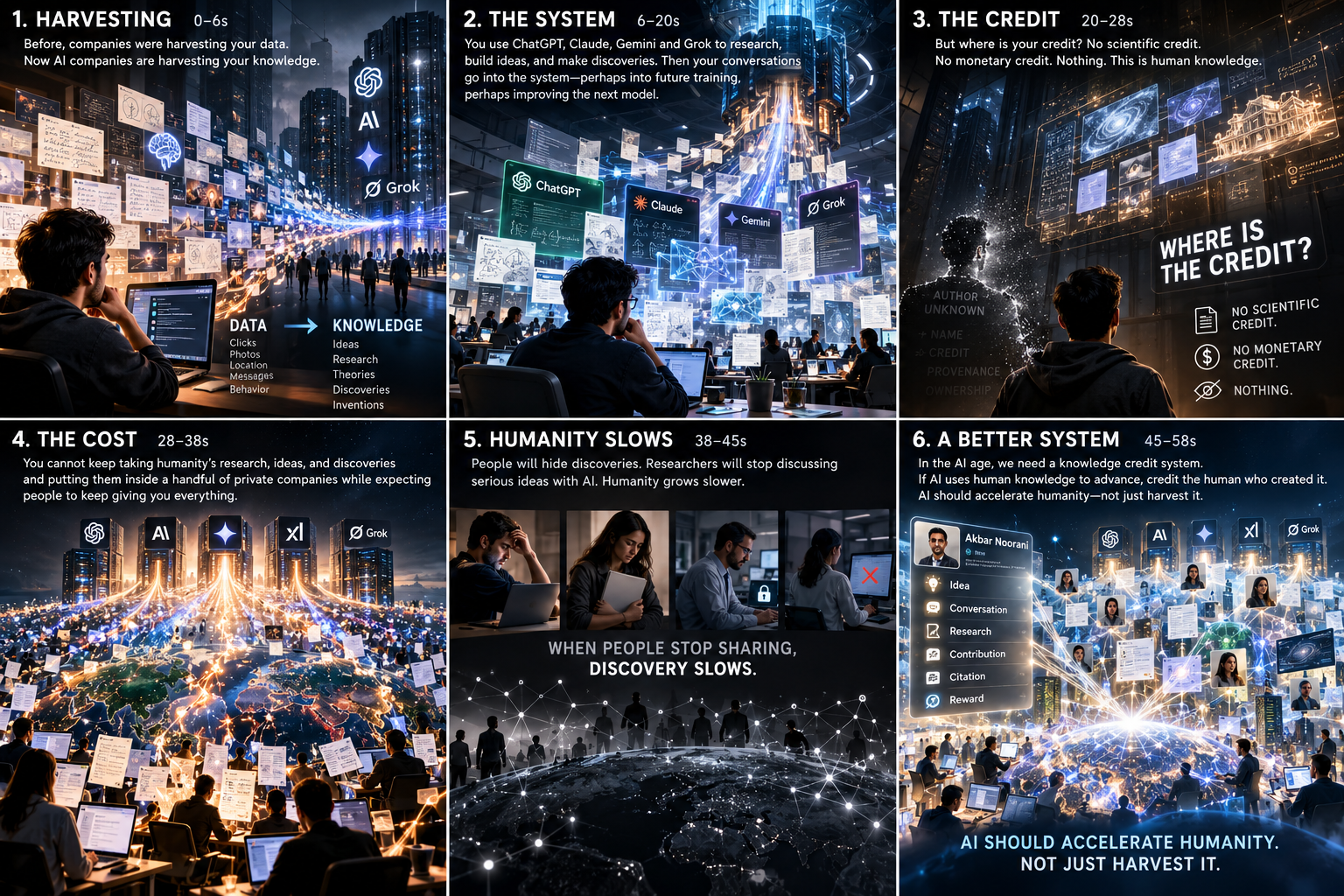
For years, the conversation around technology was about data.
Companies collected clicks, location, photos, behavior, search history, messages, preferences, and everything else they could turn into a business advantage.
But AI changes the scale of the problem.
Now we are not only giving companies our data.
We are giving them our thinking.
People are using ChatGPT, Claude, Gemini, Grok, and other AI systems to research, test ideas, develop theories, write code, connect concepts, solve problems, and sometimes make genuinely new discoveries.
That means the most valuable thing entering these systems may no longer be user data.
It may be human knowledge.
What happens when a discovery is made inside an AI conversation?
Imagine a researcher spends weeks working through an idea with an AI model.
The researcher asks difficult questions, rejects bad answers, builds a new framework, creates new terminology, develops experiments, and finally reaches something genuinely original.
Now ask a simple question:
Where does the credit go?
If that conversation is later used to improve future AI systems, the company may benefit from that knowledge.
But the human may receive:
- no scientific credit
- no authorship record
- no provenance
- no monetary benefit
- no clear evidence that the idea originally came from them
This is very different from normal data collection.
A location coordinate is data.
A purchase history is data.
A new scientific theory is not just data.
It is intellectual contribution.
We may be building the largest knowledge concentration system in history
This becomes much bigger when you look at the scale.
Billions of people could eventually use only a handful of major AI systems.
They will ask questions inside them.
They will think inside them.
They will build companies inside them.
Researchers will test theories inside them.
Engineers will solve technical problems inside them.
Doctors, scientists, designers, mathematicians, founders, and students will all pour their reasoning into a very small number of interfaces.
If all of this knowledge accumulates inside a few private systems, then we are not just centralizing computing power.
We are centralizing human intellectual activity.
That should concern everyone.
The incentive problem
There is also a practical problem.
People will eventually understand the value of what they are giving away.
A serious researcher may start asking:
Why should I develop an unpublished theory inside an AI system if I have no idea how that knowledge may be used later?
Why should a company test a new technical architecture inside a chatbot if that reasoning could eventually improve a model that is also used by competitors?
Why should a scientist expose a breakthrough before publication if there is no strong provenance system protecting their contribution?
If enough people begin thinking this way, behavior will change.
Researchers will hide discoveries.
Companies will move sensitive reasoning into closed systems.
Scientists will stop using public AI tools for serious exploratory work.
People will deliberately limit what they tell the models.
And then everyone loses.
AI becomes less useful for frontier discovery.
Humans become less willing to collaborate with AI.
Knowledge moves more slowly.
The individual company may still benefit financially.
But humanity benefits less.
We need a knowledge credit system
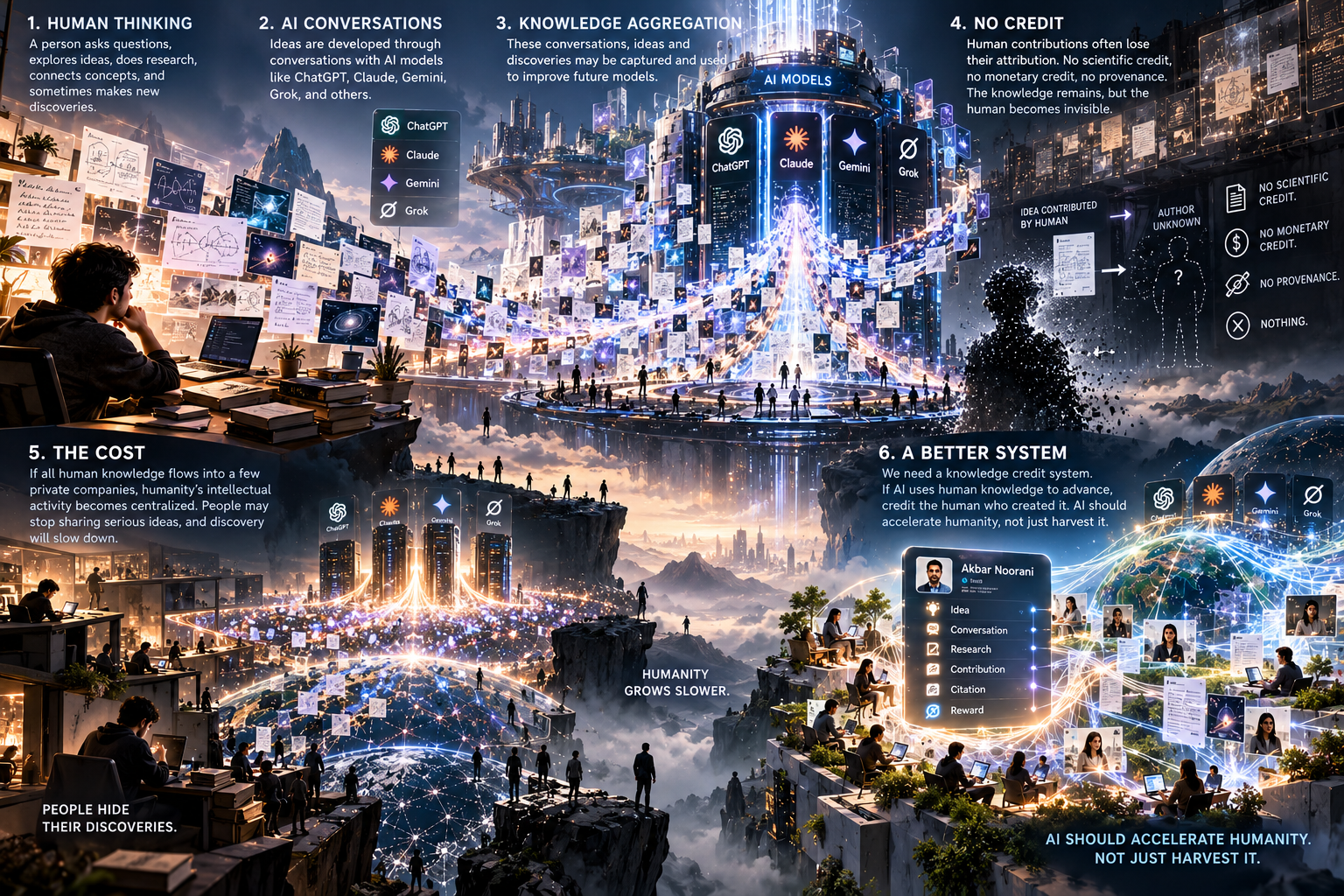
The solution cannot simply be “do not use AI.”
That would be backwards.
AI can massively accelerate human discovery.
The better answer is to build a new credit system for the AI era.
We need infrastructure that can distinguish ordinary interaction from meaningful intellectual contribution.
A future system could preserve a chain like this:
Human → Conversation → Idea → Research → Contribution → Discovery → Credit
If an idea develops through an AI system, there should be a way to preserve where it came from.
That could include:
- timestamped provenance
- authorship records
- contribution history
- permission for training use
- citation lineage
- research attribution
- possible financial compensation where appropriate
Think of it as something similar to version control for knowledge.
Git tells us who changed code, when they changed it, and how the project evolved.
Scientific citation tells us which earlier work contributed to later work.
AI systems may need something similar for human knowledge.
Not every message deserves payment
This does not mean every prompt should become a royalty claim.
Most conversations are ordinary.
Most ideas are not novel.
Most model interactions will not deserve scientific authorship or financial compensation.
The challenge is to build systems that can identify meaningful contribution without turning every conversation into an ownership dispute.
But the fact that this is difficult does not mean we should ignore it.
The important principle is simple:
Human knowledge should not become invisible just because it passed through an AI interface.
The next AI debate is bigger than privacy
Privacy asks:
Who can see my data?
Ownership asks:
Who controls my data?
But the next question may be:
Who contributed the knowledge?
That is a much more important question in a world where AI becomes the place where people think.
If AI systems become the primary environment for research and discovery, then they also become part of humanity’s intellectual infrastructure.
That infrastructure should not erase the humans who contribute to it.
AI should accelerate humanity, not just harvest it
The goal should not be to stop AI companies from improving their models.
The goal should be to make sure human contribution remains visible inside that progress.
AI should make researchers more powerful.
It should make discoveries faster.
It should help humanity connect ideas that would otherwise remain separate.
But if the system rewards only the company operating the model while the humans supplying new knowledge disappear from the record, eventually people will stop trusting the system.
The better future is one where AI and humans grow together.
Where knowledge can move freely without losing its origin.
Where researchers are encouraged to share because contribution can be recognized.
Where AI does not become a black hole for intellectual credit.
We spent the last decade debating ownership of human data.
The next decade may force us to debate something much more important:
ownership, provenance, and credit for human knowledge itself.